53 Urban Taxonomy
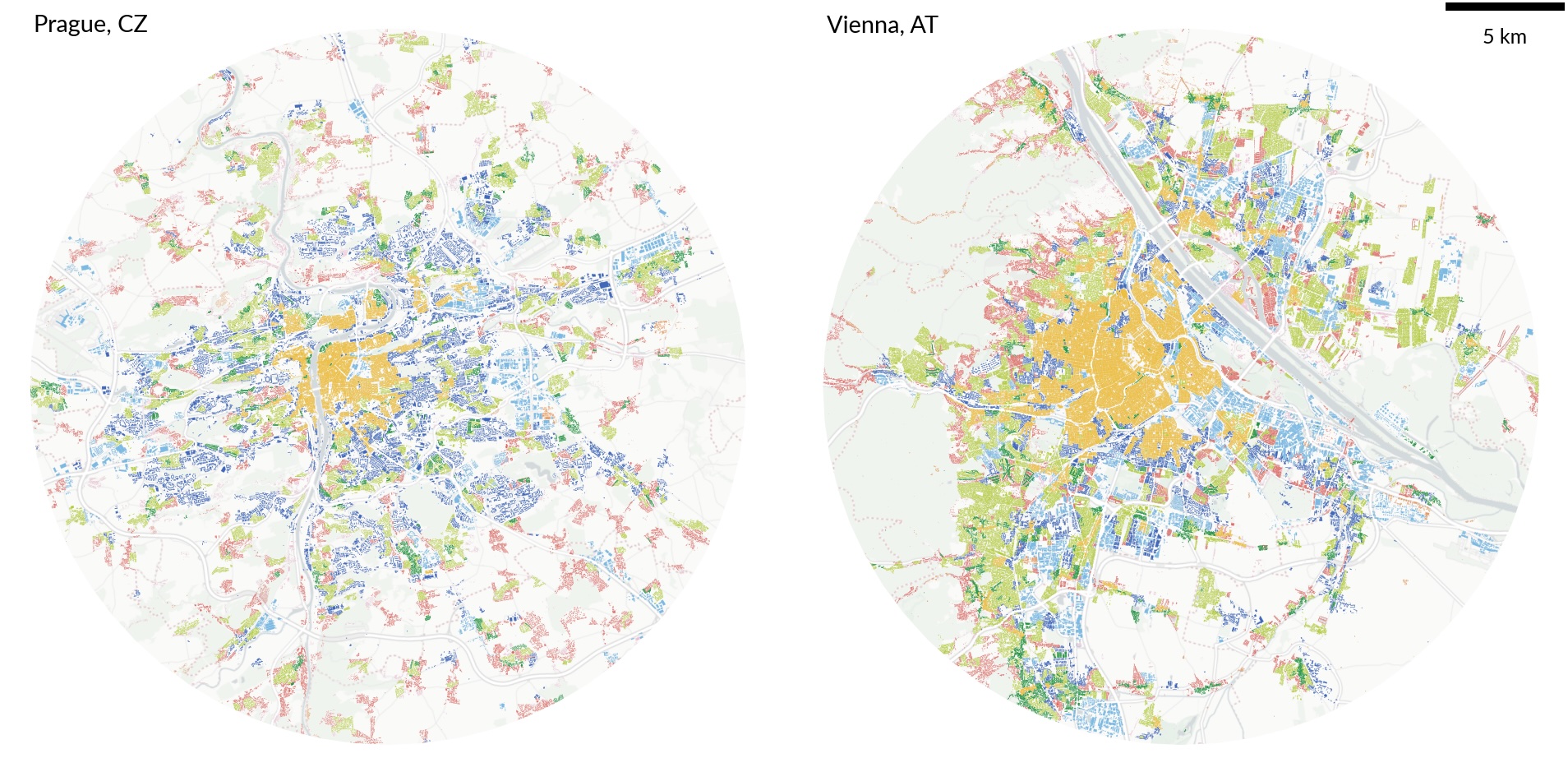
The Urban Taxonomy is an example of typology construction that uses hierarchical morphotope classification. It builds upon Conzen’s notion of a morphotope: the smallest unit of morphologically homogenous land and uses these to identify patterns and cluster morphologically similar areas together. This method works by ‘clustering’ similar points in a given dataset, thereby allowing you to identify different groups, or typologies. This approach allows you to process and analyse large datasets with many variables that would be impossible to do manually. In the Urban Taxonomy, patterns of urban form are classified into the following typologies of urban fabric: Coherent Interconnected Fabric, Coherent Dense Adjacent Fabric, Coherent Dense Disjoint Fabric, Incoherent Large-Scale Homogenous Fabric, Incoherent, Large-Scale Heterogenous Fabric, Incoherent Small-Scale Linear Fabric, Incoherent Small-Scale Sparse Fabric, and Incoherent Small-Scale Compact Fabric. As can be seen in Figure 1, the clear graphic style of an analysis like this allows you to easily compare between different cities at the same scale.